
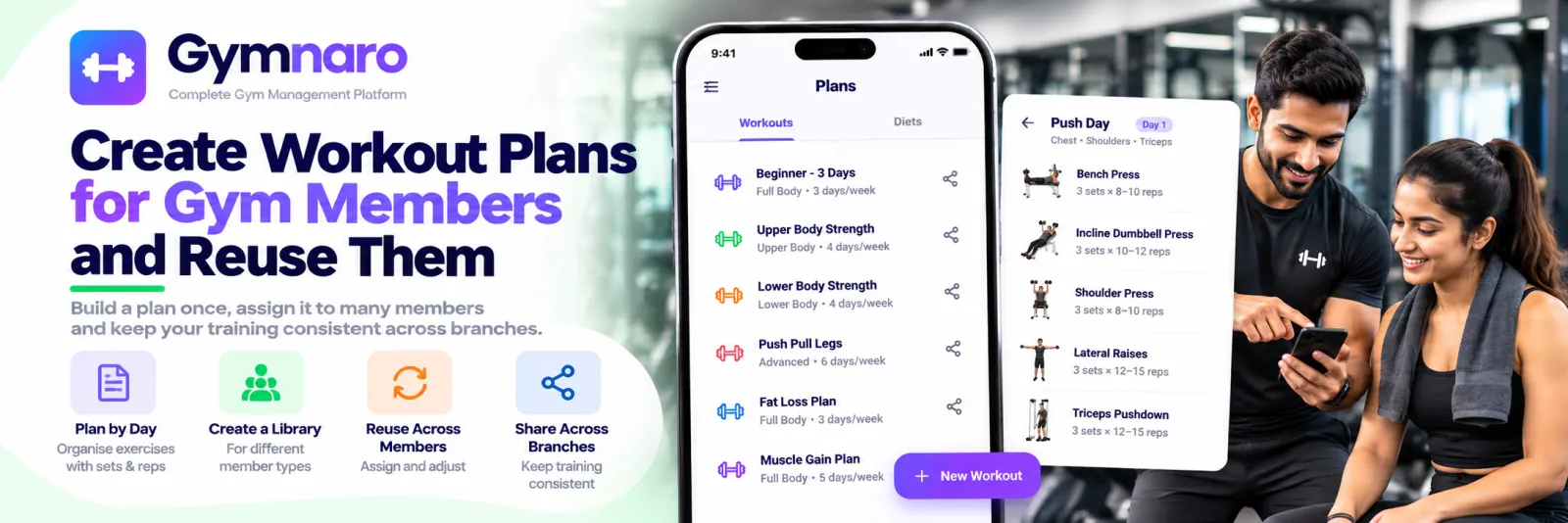
If every member's plan is written from scratch, trainers spend their time on paperwork instead of coaching. A small library of well-structured plans that you assign and adjust is faster and more consistent.
Plan by day
A day-wise plan is easy for both trainer and member to follow. For each training day, list the exercises in order with sets and repetitions. A simple structure such as upper body, lower body and full body days is easy to explain and repeat.
Build for a type of member, not one person
Think in groups: a beginner plan, a plan for a member who trains three days a week, a plan for building strength. A plan built for a group can be assigned to many people and adjusted for one.
Name plans clearly
A name like "Beginner, 3 days a week" tells everyone what it is for. Vague names turn a library into a pile that nobody uses.
Give every plan a start and an end
A plan should not run forever. Assign it with a start date and an end date, and review the member's progress when it ends. That review is a natural point to update the plan, check measurements and talk about the next goal.
Share plans across branches
If you run more than one gym, build the plan once and share it, so every branch trains members the same way. Keep a plan private when it is specific to one gym or one trainer.
A simple structure for one plan
For each training day, write the day's focus, then the exercises in order. For each exercise add the number of sets and repetitions and a note where it matters, such as the tempo or the rest between sets. Keep each day to what a member can finish in their usual session length.
Choosing a weekly structure
Three common ways to organise a week:
- Full body, three days: simple, and suited to beginners who train three days a week.
- Upper and lower, four days: a good step up for members with some experience.
- Push, pull and legs, five or six days: for experienced members who can train most days.
Pick the structure that matches the member's available days. A realistic plan they follow is better than an ideal plan they miss.
Plan for progression
A plan should say how a member moves forward: add a little weight, add repetitions, or move to a harder variation when the current one feels comfortable. Write the rule in the plan so a member and any trainer can apply it the same way.
Adjust for the individual
A shared plan is a starting point. Before assigning it, the trainer should check for injuries, limitations and the member's goal, and adjust exercises accordingly. Keep a note of what was changed and why.
Review when it ends
At the end date, look at the member's attendance and measurements with them. Decide whether to repeat the plan, move to the next level or change direction, then assign the next plan with new dates.
Common mistakes
- Overloading beginners. A plan that is too long gets abandoned in week two.
- No end date. Without a review point the plan quietly goes stale.
- Copying a plan without adjusting it. Injuries, goals and experience differ between members.
- Unclear names. A library of plans called "Plan 1", "Plan 2" is impossible to use.
Questions owners ask
How long should a plan last?
That is a coaching decision. Many trainers review after a set number of weeks. Whatever you choose, assign an end date so a review happens.
Can several trainers share plans?
Yes. A shared library helps the whole gym coach in a consistent way, as long as plans are named clearly.
How this works in Gymnaro
- Build day-wise workout plans and keep them in a plan library.
- Keep plans private or share them across your gyms.
- Assign a plan to a member with a start and end date.
- Members see their assigned plans in their own app.
See the workout and diet plans page and how to structure diet plans.
← All posts · Guides · Pricing