Most money problems in a gym are not about money. They are about records: a payment that was taken but not written down, a discount nobody remembers, or a membership that says paid when it is not. A small, consistent routine fixes most of it.
What to record for every payment
- Member, and the membership the payment is for.
- Amount actually received.
- Date of the payment.
- Payment mode: how it was paid.
- Discount, if any, so the amount makes sense against the package price.
- Status: paid, part-paid or pending.
Record it the moment you take it
The longer a payment sits unrecorded, the more likely it is to be forgotten or entered wrongly. Enter it at the desk while the member is still there. If you give a receipt, give it at the same moment.
Handle discounts in the open
A discount is a decision. Record it with the payment, with the amount, so that your monthly total and your package prices still reconcile. A discount hidden inside a lower price makes every report harder to trust.
Part payments and pending amounts
When a member pays part of the fee, record what was paid and mark the status so the balance is visible. A pending status is a reminder to you that there is something to collect, and it stops a part payment looking like a full one.
Receipts
A receipt protects both sides. It gives the member proof and gives you a record that matches the entry. Keep the receipt tied to the payment, not written separately.
Reconcile at the end of every day
Count the cash, add up the other payments recorded and compare the two totals with what you actually hold. A difference of any size is easier to trace the same evening than at the end of the month. Make it a habit, and let whoever closes the gym do it.
Decide how you handle refunds and cancellations
These are rare, but they cause the most arguments. Decide your policy in advance, write it down where members can read it, and record each case you handle. Whatever tool you use, the record should show what was returned, to whom and why, so your totals still make sense.
Be clear about fees at joining
Tell new members the package price, any joining or admission fee, and what is included, before they pay. Most disputes about money come from a fee that was understood differently by two people. A clear explanation at the start, with the same figures on the receipt, prevents them.
Keep one source of truth
If payments are recorded in a register, a sheet and a phone, they will not agree. Choose one place for the official record and make everyone use it. Any other note is a reminder, not the record.
Common mistakes
- Recording at the end of the day. Entries made from memory are the ones that go wrong.
- Marking a part payment as paid. It hides money still to be collected.
- Discounts nobody can explain. If a discount was not written down with the payment, you cannot tell later whether it was agreed.
- Two records of the same payment. A register and a sheet that both get updated will eventually disagree.
A simple month-end routine
- List all payments with status pending or part-paid and decide who to contact.
- Compare the month's total payments with what you actually received.
- Check any discount that is larger than usual and note why it was given.
- Export the payments if your accountant needs them.
Questions owners ask
Should every payment have a receipt?
It is good practice. A receipt takes seconds and removes most later disagreements.
What if a member pays in instalments?
Record each instalment as its own payment against the same membership, so the history shows what was paid and when.
How this works in Gymnaro
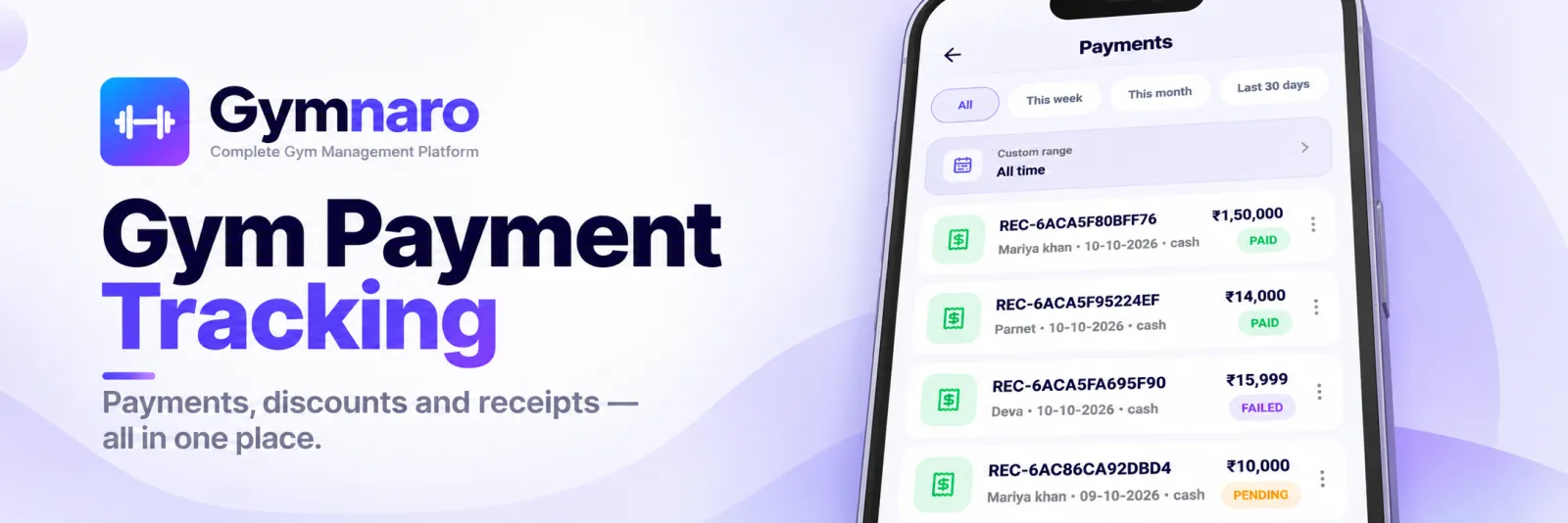
- Record each payment with amount, date, payment mode, discount and status.
- Open a receipt for any payment.
- See this month's revenue on the dashboard.
- Export payments to CSV when you need them elsewhere.
Payments also feed the profit and loss report next to your expenses. See renewals and payments and how to track gym expenses and profit and loss.
A weekly check
Once a week, look at the list of pending payments and compare this week's total with what is in the till and the bank. If they differ, you find out while it is still easy to trace.
← All posts · Guides · Pricing